It’s time to place students at the center of our classroom practice and assessment systems. This requires leadership that not only values innovation but is prepared to implement it. BBAF 2026 will focus on how educational leaders can translate innovative ideas into sustainable, student-centered assessment practices across classrooms, schools, and systems.
The Building a Better Assessment Future Conference is in its sixth year of bringing together educators from all over the country to connect around assessment. This two-day conference features three expert keynote speakers and 13 breakout sessions in small group settings that will delve into topics across three conference strands: systems, leadership, and classroom. Together, these strands will explore the assessment knowledge, practices, and policies educational leaders need to lead innovation.
Keynotes
Lillian Pace opens the conference with her keynote, “Empowering Creativity in an Era of Federal Change.” Pace will examine the evolving education landscape and its impact on assessment systems, including exploring the shifting role of the federal government and examples of promising assessment innovation, to provide insights on how to better meet the needs of educators, students, and communities.
Steven Snead’s keynote, “Is the Future of Assessment A.I. or D.E.I.?,” will explore artificial intelligence (A.I.) and diversity, equity, and inclusion (D.E.I.) and how they can collide, conflict, and ultimately co-create a more just, accurate, and actionable assessment future.
Jill Willis closes the conference with her keynote, “Accessible Assessment for Learning and Agency: How small classroom choices can create powerful possibilities for the future.” Willis will examine the balance between measuring content standards and cultivating transferable skills that lay outside them. She will invite us to consider how opening multiple pathways for students to demonstrate their learning can ignite engagement, strengthen self-efficacy, and deepen metacognition.
Conference participants will:
- Explore practices and policies that support the design and implementation of innovative, student-centered assessment systems
- Examine how research can sustain assessment innovation over time
- Consider implications for assessment practices and policies as systems shift toward learner-centered approaches
- Envision the future of assessment when all levels of the system are aligned and all stakeholders are assessment literate
- Learn from practitioner stories that illustrate transformation in classroom practice and complex systems change
Participants will also be invited to reflect on their own roles in advancing the assessment future we collectively imagine.
Overview
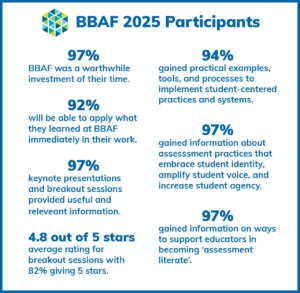
BBAF’s design as a smaller, more intimate conference provides opportunities to network and connect with fellow educators, breakout session leaders, and keynote speakers. Over the two days, three blocks of concurrent breakout sessions in a small group setting will feature expert practitioners who will highlight practice, structures, and policies necessary to achieve and sustain student-centered assessment systems by providing examples, tools, and processes to implement for student success.
Student perspectives will be intentionally highlighted throughout the conference, alongside Field Notes from educators currently implementing assessment innovations in their contexts, with opportunities to reflect and journal. There will be a curated, upbeat music playlist throughout the conference, catered lunches, a photo station, and a Mix & Mingle reception at the end of the first day for drinks and visiting with new and old friends! On the second day, early risers can join us for a hot breakfast and coffee at 7:30 a.m. while engaging in dialogue around forward-thinking topics related to assessment.
Who should attend?
Teachers, administrators, assessment policymakers, and district teams.
Attend as an individual or as a team!
We are here to connect, get inspired, learn from one another, and gain applications for next steps. While individuals are welcome, we encourage schools/districts to register and work in teams of 3 or more, as it can help strengthen professional relationships and collaboration, while enhancing the capacity for systems change with a shared vision and goals. The MAC supports participants post-conference by providing recorded conference archives and opportunities to join 2026–27 networks and events.
The conference is co-hosted by The Michigan Assessment Consortium (MAC), in partnership with Michigan Department of Education (MDE) and MDE’s Formative Assessment for Michigan Educator’s (FAME) Program.
An early registration discount applies automatically through May 31, 2026.
9.5 SCECH credits available
Watch a brief preview of what you can expect at BBAF!